

Create Privacy Policy in 2026: 7 Live Checks Before You Publish
A useful guide to create privacy policy should help readers understand both the rule and the behavior behind the rule. That is where consent topics become genuinely practical instead of sounding like recycled compliance copy.
The practical review for create privacy policy starts when you look past the banner copy and test the live behavior. That is usually where teams find the real gaps: tags firing too early, weak refusal flows, and settings that drift after routine site changes.
That is where the official sources still line up. The California Privacy Protection Agency’s regulations effective January 1, 2026 say the purpose of the privacy policy is to provide consumers with a “comprehensive description” of a business’s online and offline information practices and the information needed to exercise their rights. GDPR Article 12 still requires privacy information to use “clear and plain language.” California’s Department of Justice still says a business’s privacy policy should be “updated at least once a year.” WordPress still tells plugin developers that any plugin handling personal data should add “suggested text to the privacy policy postbox.” And the UK’s ICO finalized guidance on “storage and access technologies” in April 2026, which is a better match for how live sites now use cookies, pixels, scripts, and similar tracking tools.
If you want the nearest companion reads first, start with these guides to privacy policy template, privacy policy for website, and website privacy policy template. This page stays focused on the practical work of create privacy policy projects this week.
If your team is trying to get create privacy policy under control without adding a heavyweight privacy stack, DataShyre can help. DataShyre focuses on consent and preference management that are easier to implement, easier to operate, and easier to trust on a live site. Start with DataShyre’s consent and preference management or book a demo.
If your team wants help turning a draft into a page that actually matches the live stack, DataShyre can help with data mapping, consent management, and DSR automation. The hard part is rarely getting words on the page. It is proving those words still match what forms, tags, apps, and vendors are doing in production.
1. Start with the live stack, not with the draft
The first create privacy policy mistake is treating the policy as the source of truth.
It is not.
Your live collection and sharing behavior is the source of truth. The policy is the public explanation of that behavior.
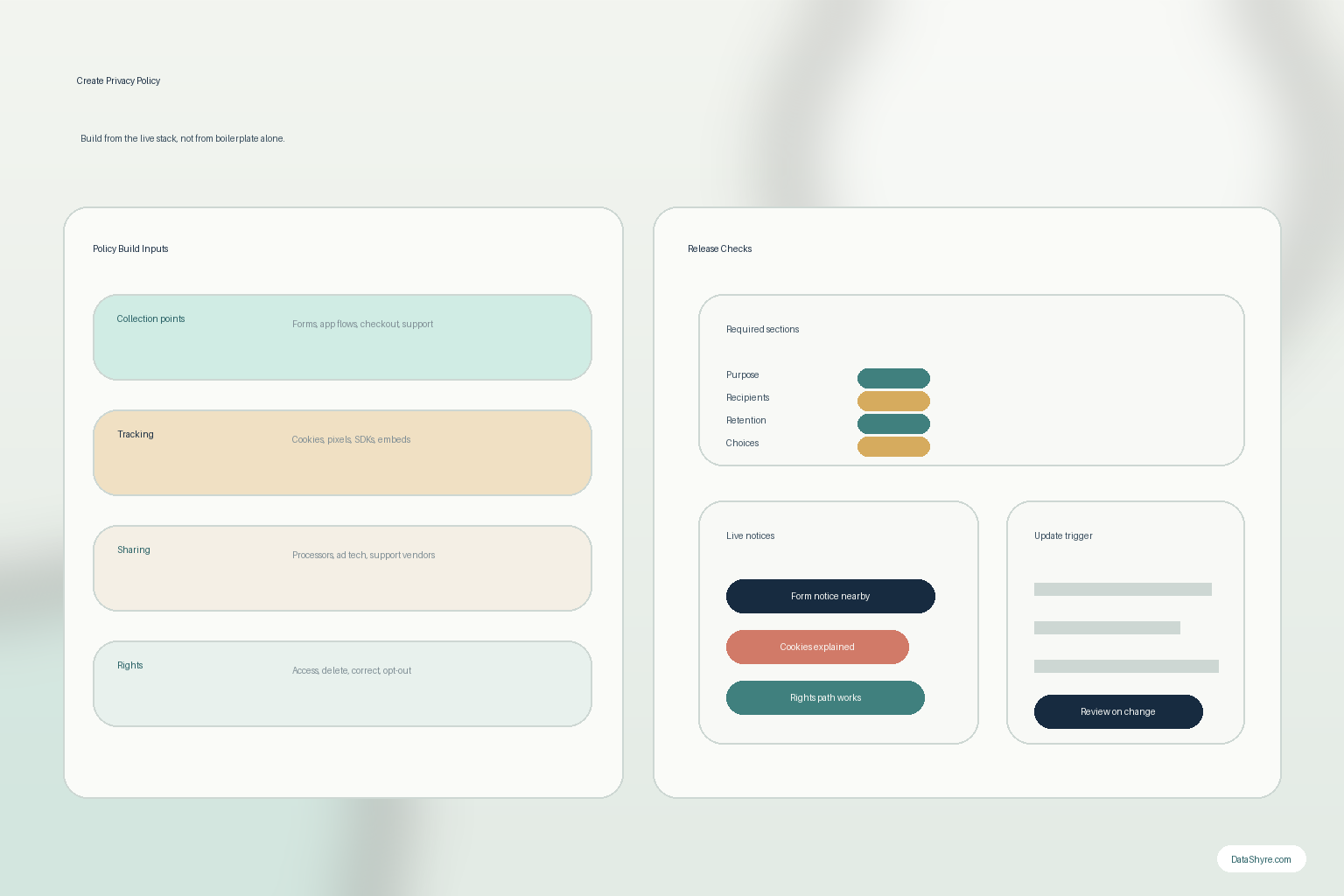
So before you draft anything, inventory:
- every form, signup, checkout, demo, support, and app flow that collects personal information;
- the categories of personal information collected in each flow;
- the vendors or processors that receive the data;
- the cookies, pixels, SDKs, embeds, and analytics tools tied to those journeys; and
- the rights, consent, or opt-out controls users are supposed to have later.
If you skip that mapping step, the policy usually becomes a clean-looking guess.
2. Cover the disclosure blocks the current rules still expect
A weak create privacy policy workflow often starts with tone and ends with missing facts.
The current California regulations still expect a privacy policy to give a meaningful description of online and offline information practices. In real deployments, a working page usually needs to explain:
- the categories of personal information collected;
- the sources of that information;
- the business or commercial purposes for using it;
- the categories of third parties or service providers receiving it;
- retention periods or the criteria used to decide them;
- the consumer rights or data-subject rights available in scope;
- how to exercise those rights and contact the business.
GDPR-facing teams usually need the same operational discipline plus the GDPR-specific pieces around lawful basis, recipients, transfers where relevant, and rights.
So if your create privacy policy process cannot answer who gets the data, why they get it, how long it stays, and what the person can do about it, the page is not ready.
3. Put the notice where collection happens, not only in the footer
This is where many create privacy policy projects still fail.
The page in the footer matters. But it is not the only notice moment that matters.
California’s current regulations still require Notice at Collection to be provided at or before the point of collection. For webforms, the regulations specifically allow a conspicuous link placed close to the fields or near the button.
That means a serious create privacy policy review should check whether:
- contact, demo, quote, newsletter, and download forms expose the right notice nearby;
- mobile layouts still show the notice clearly;
- app landing pages or downloads also expose the policy where required;
- the short notice and the full policy tell the same story; and
- people can reach the relevant section without wading through an unrelated wall of text.
If the user only sees the disclosure after submitting the form, the notice arrived too late.
4. Explain cookies, pixels, and similar tracking honestly
Many teams still create privacy policy pages as if the website only collects what users type into forms.
That is usually false.
The ICO’s finalized 2026 guidance is useful because it uses the broader label “storage and access technologies.” That includes cookies, tracking pixels, scripts, tags, web storage, and fingerprinting techniques. The FTC’s consumer guidance uses a similar practical model and explains that websites and apps may track people with cookies, pixels, or fingerprinting for analytics, personalization, and advertising.
So a credible create privacy policy workflow should explain:
- what tracking or storage technologies are used;
- whether they support necessary functions, analytics, advertising, personalization, or support;
- whether another company receives data through them;
- how consent or opt-out controls affect them; and
- where users can revisit those choices later.
That does not mean pasting a giant scanner export into the page.
It means not pretending the business is form-only when the live site also runs trackers and third-party scripts.
5. Make the rights section operational, not decorative
Another common create privacy policy failure is listing rights without showing the path to use them.
That makes the page sound responsible while leaving the real user stuck.
A practical rights section should help a person understand:
- which rights or controls apply in the relevant jurisdictions;
- how to submit a request;
- where to find privacy settings, cookie preferences, or opt-out controls;
- what verification or follow-up may be required;
- how the business handles browser-based signals or other automated controls where relevant; and
- how to contact someone when the self-serve path fails.
If your create privacy policy draft names the rights but hides the actual route, it is acting like a brochure, not an operating page.
6. For WordPress, treat plugin text as starter text only
This is one of the clearest checks for WordPress teams trying to create privacy policy pages fast.
WordPress still expects plugins that collect, use, store, or pass user data to third parties to contribute suggested privacy-policy text. That is useful, because it can surface vendor-specific details the core page owner may overlook.
But that text is not a finished policy.
For a WordPress stack, your create privacy policy review should still compare the draft against:
- the plugins actually active in production;
- the forms, comments, ecommerce, booking, and support flows on the site;
- the cookie or consent tooling tied to those flows;
- the privacy choices or request tools users can access later; and
- any custom code, embeds, or tag-manager logic running outside the plugin text.
If your team is struggling to reconcile plugins, forms, tags, and rights flows into one truthful public page, DataShyre can help map the runtime behavior and turn the policy layer into something operational instead of aspirational.
7. Tie updates to change, not only to the calendar
California’s Department of Justice still says the privacy policy should be “updated at least once a year.”
That is a minimum.
For most teams, the better create privacy policy operating model is to re-review the page whenever:
- a new form or field goes live;
- a new vendor, pixel, SDK, or embed is added;
- the business starts using data for a new purpose;
- retention logic changes;
- the rights path or privacy settings flow changes; or
- the mobile app, WordPress stack, or marketing tooling changes how data moves.
That change-based trigger is how the page stays believable after launch.
A practical create privacy policy order for this week
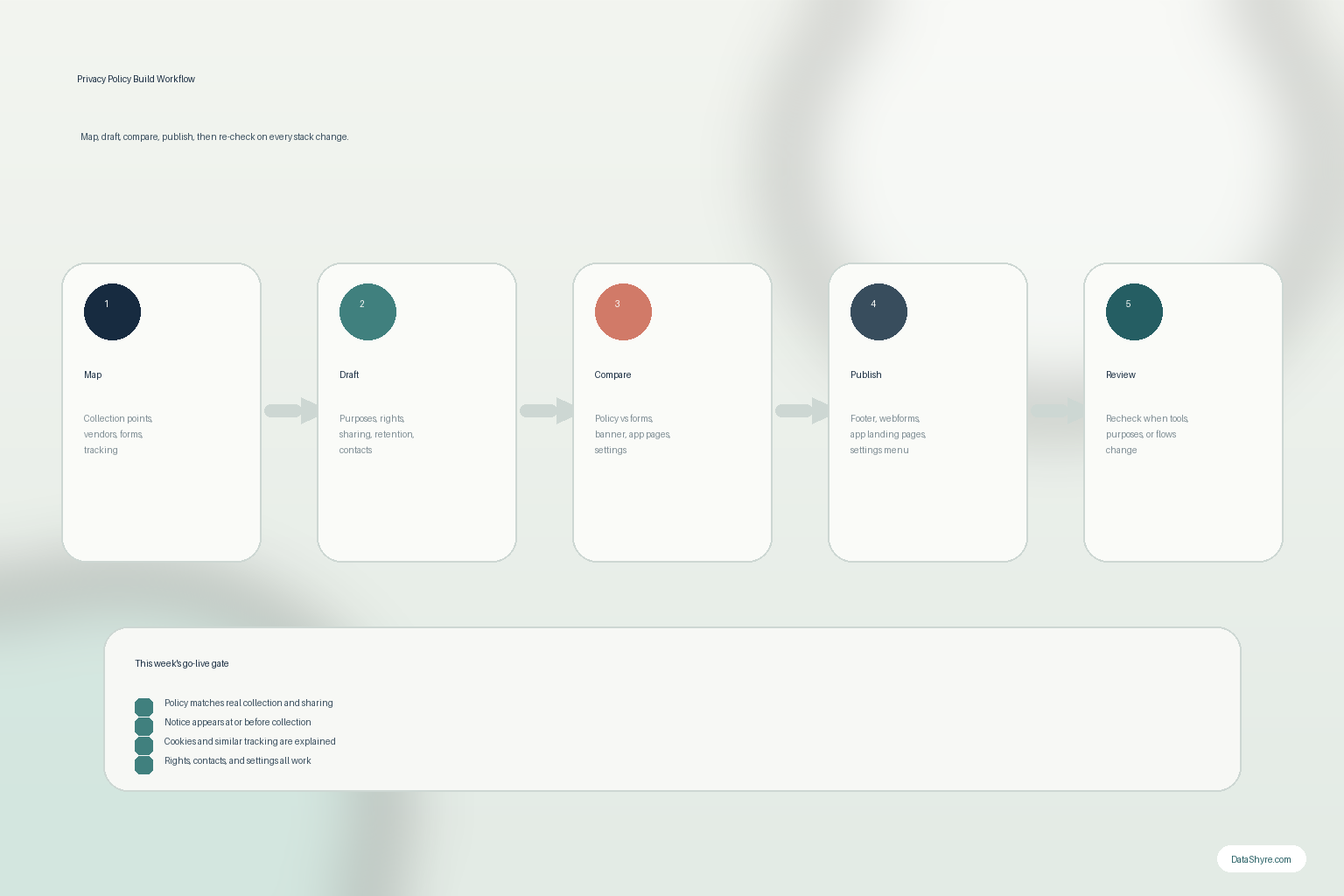
If I were helping a team create privacy policy content today, I would use this order:
- map live collection points, tracking, vendors, and rights paths;
- draft the required sections for categories, sources, purposes, recipients, retention, rights, and contacts;
- check notice-at-collection placement on every form or collection surface;
- review cookies and similar tracking against the real runtime behavior;
- compare WordPress or platform-generated suggested text against the actual stack;
- test the request, settings, and privacy-choice routes users are promised; and
- set the next policy review trigger before the next release.
That order catches more truth than writing the prettiest legal page first.
FAQ
Can I create privacy policy pages from a generator alone?
You can start there, but you should not stop there. A generator can help with structure. It cannot verify the live forms, vendors, trackers, and rights flows already running on your site.
What should I gather before I create privacy policy content?
At minimum, gather your collection points, the data categories involved, your purposes, your vendors or processors, your tracking tools, your rights workflow, and your retention logic.
Do I need a separate cookie explanation when I create privacy policy content?
Usually yes if the site uses cookies, pixels, tags, or similar technologies. The policy should explain them honestly or clearly point to the related cookie or preference layer without contradiction.
Bottom line
The best create privacy policy workflow in 2026 is not the one that publishes fastest.
It is the one that starts from the real stack, explains the real practices, puts notice where collection happens, covers tracking honestly, makes rights usable, and forces review when the system changes.
If the page does that, it can build trust.
Seen clearly, create privacy policy is less about a pop-up and more about whether the site behaves honestly after the visitor makes a choice.
Sources
- California Privacy Protection Agency, CCPA Regulations Effective January 1, 2026: https://cppa.ca.gov/regulations/pdf/ccpa_statute_eff_20260101.pdf
- California Department of Justice, How to Read a Privacy Policy: https://oag.ca.gov/privacy/facts/online-privacy/privacy-policy
- EUR-Lex, Regulation (EU) 2016/679 (GDPR), Article 12: https://eur-lex.europa.eu/legal-content/EN/TXT/?uri=CELEX:32016R0679
- ICO, What are storage and access technologies?: https://ico.org.uk/for-organisations/direct-marketing-and-privacy-and-electronic-communications/guidance-on-the-use-of-storage-and-access-technologies/what-are-storage-and-access-technologies/
- FTC Consumer Advice, How Websites and Apps Collect and Use Your Information: https://consumer.ftc.gov/articles/how-websites-and-apps-collect-and-use-your-information
- WordPress Plugin Handbook, Suggesting text for the site privacy policy: https://developer.wordpress.org/plugins/privacy/suggesting-text-for-the-site-privacy-policy/